
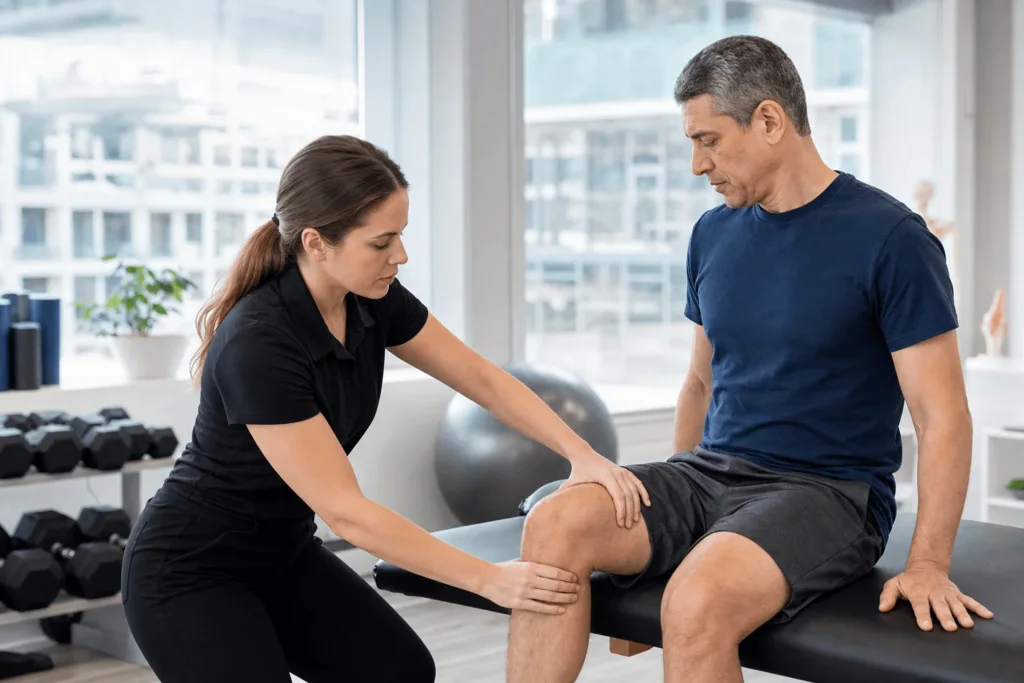
Knee pain affects millions of Canadians each year, limiting mobility and quality of life. Whether you’re dealing with a sports injury, arthritis, or chronic discomfort, physiotherapy for knee pain offers evidence-based treatment that addresses both symptoms and underlying causes. At ProMed Wellness Centre in North York, we see patients with knee conditions ranging from acute ACL tears to degenerative osteoarthritis, and physiotherapy consistently delivers measurable improvements in pain, function, and long-term outcomes.
This guide covers everything you need to know about physiotherapy treatment for knee pain. You’ll learn what causes knee discomfort, when to seek professional help, what happens during your first assessment, and the specific exercises and techniques that accelerate recovery.
Quick Answer
Physiotherapy treats knee pain through targeted exercises, manual therapy, and pain management techniques that reduce inflammation, restore mobility, and strengthen supporting muscles. Treatment duration varies by condition, with many patients noticing improvement within the first few weeks of consistent therapy.
Common Causes of Knee Pain: Understanding Your Condition
The knee is a complex joint vulnerable to both acute injuries and gradual wear. Understanding what’s causing your pain helps guide treatment decisions.
Degenerative Conditions
Osteoarthritis is the most common cause of chronic knee pain in adults over 50. The cartilage that cushions your knee joint gradually breaks down, causing bone-on-bone friction, inflammation, and stiffness. You’ll typically notice pain that worsens with activity and improves with rest.
Patellofemoral pain syndrome affects the cartilage under your kneecap. It’s common in runners and office workers who sit for extended periods. The pain usually appears around or behind the kneecap and intensifies when climbing stairs or squatting.
Acute Injuries and Overuse Conditions
ACL (anterior cruciate ligament) tears are severe injuries often occurring during sports that involve sudden stops or direction changes. Meniscus tears happen when you twist your knee while bearing weight, causing pain, swelling, and sometimes a catching or locking sensation.
Patellar tendinitis, also called jumper’s knee, affects the tendon connecting your kneecap to your shinbone. Iliotibial band syndrome occurs when the thick band of tissue running from your hip to your shin becomes tight and rubs against the outer knee bone.
Key Takeaways
- Identify whether your knee pain is acute or chronic before starting treatment.
- Seek physiotherapy early to prevent minor knee issues from becoming chronic problems.
- Watch for red flags that require immediate medical attention versus physiotherapy.
- Combine manual therapy with targeted exercises for faster knee pain recovery.
- Maintain strength and flexibility long-term to prevent future knee problems.
Self-Assessment: When to See a Physiotherapist for Knee Pain
Many people wait too long before seeking professional help, allowing minor issues to become chronic problems. You don’t need a referral to see a physiotherapist in Ontario, and direct billing is available at our North York physiotherapy services for most insurance plans.
Red Flags Requiring Immediate Medical Attention
Seek emergency care before physiotherapy if you experience severe swelling within two hours of injury, cannot bear weight on the leg, notice visible deformity, or feel the knee giving out repeatedly. These symptoms may indicate fractures, complete ligament tears, or other serious injuries requiring imaging and possibly surgery.
Comprehensive Self-Assessment Tool
Use this scoring system to determine your need for physiotherapy. Award 1 point for each yes answer. Pain Duration: Has your knee pain lasted more than two weeks despite rest and ice? (1 point). Functional Limitation: Are you avoiding stairs, squatting, or kneeling due to knee discomfort? (1 point). Activity Modification: Have you stopped or reduced exercise, sports, or recreational activities because of knee pain? (1 point). Morning Stiffness: Does your knee feel stiff for more than 30 minutes after waking? (1 point). Swelling: Do you notice recurring swelling in your knee after activity? (1 point). Instability: Does your knee feel unstable or like it might give out? (1 point). Night Pain: Does knee pain wake you at night or prevent comfortable sleep? (1 point). Previous Injury: Have you injured this knee before without completing rehabilitation? (1 point).
Score Interpretation: 0-2 points suggests home management with rest, ice, and over-the-counter pain relief may be sufficient. Monitor symptoms for one week. 3-5 points indicates physiotherapy assessment is recommended within two weeks. Early intervention prevents compensation patterns. 6-8 points means schedule physiotherapy assessment within one week. Delaying treatment may lead to chronic issues affecting your hip or back.
Ready to start your recovery?
Our multidisciplinary team in North York offers physiotherapy, chiropractic, massage therapy, and more under one roof. Direct billing available, no referral needed.
What to Expect During Your First Physiotherapy Assessment
Your initial physiotherapy assessment for knee pain typically takes 45-60 minutes. The assessment starts with a detailed history about when the pain began, what makes it better or worse, previous injuries, and your activity level.
Physical examination includes observing how you walk, measuring range of motion, and evaluating quadriceps, hamstrings, and hip muscle strength. Special tests identify specific structures causing pain. The Lachman test checks ACL integrity, McMurray’s test detects meniscus tears, and the patellar grind test assesses cartilage under the kneecap.
After the assessment, your physiotherapist explains findings and outlines a treatment plan with estimated recovery timeline. At ProMed Wellness Centre, we involve patients in goal-setting to ensure treatment aligns with what matters most to you.
How Physiotherapy Treats Knee Pain: Evidence-Based Approaches
Physiotherapy for knee pain relies on multiple treatment techniques tailored to your specific condition. Research from the Journal of Orthopaedic & Sports Physical Therapy shows that combining approaches delivers better outcomes than single-method treatment.
Manual Therapy and Pain Management Techniques
Manual therapy techniques address joint stiffness and soft tissue restrictions. Joint mobilizations involve gentle, controlled movements that restore normal knee mechanics. Soft tissue mobilization targets tight muscles and fascia around the knee. Patellar mobilizations are particularly effective for patellofemoral pain syndrome.
Therapeutic Modalities for Knee Pain Relief
Therapeutic ultrasound treatment uses sound waves to promote tissue healing and reduce inflammation. Electrical stimulation (TENS) reduces pain by blocking pain signals. Kinesiology taping provides external support and sensory feedback that improves movement patterns.
Treatment Outcomes: Physiotherapy Alone vs. Combined Approaches
Research demonstrates that combined treatment approaches outperform single interventions. A 2019 systematic review in Physical Therapy journal found physiotherapy combined with manual therapy produces 30-40% better outcomes than exercise alone for patellofemoral pain syndrome. For knee osteoarthritis, a Cochrane review showed physiotherapy plus patient education achieves 65-70% improvement in pain and function scores compared to 40-50% with education alone. A 2020 study in the American Journal of Sports Medicine found post-surgical ACL patients who receive physiotherapy combined with neuromuscular training return to sport 2-3 months faster than those receiving standard rehabilitation only. The multidisciplinary approach at ProMed Wellness Centre allows seamless integration of physiotherapy, massage therapy, and chiropractic care.
Age-Specific Treatment Approaches for Different Populations
Knee pain treatment varies significantly based on age, activity level, and lifestyle. Understanding these differences ensures you receive appropriate care tailored to your specific needs.
Athletes and Active Individuals (18-35)
Athletes require aggressive rehabilitation focused on sport-specific movements and rapid return to competition. Treatment emphasizes plyometric exercises, agility drills, and neuromuscular control. Recommended exercises include single-leg hops, box jumps (progressing from low to high), lateral shuffles with resistance bands, and deceleration training. Recovery timelines are shorter but demand strict adherence to protocols. Athletes often combine physiotherapy with sports massage and performance training.
Office Workers and Sedentary Adults (35-55)
Office workers typically present with patellofemoral pain from prolonged sitting and weak hip stabilizers. Treatment focuses on correcting posture, strengthening neglected muscle groups, and improving workplace ergonomics. Recommended exercises include glute bridges, clamshells, wall sits with proper alignment, and hip flexor stretches. Workstation modifications matter: adjust chair height so knees are level with hips, take standing breaks every 30 minutes, and use a footrest if needed. Many patients benefit from standing desk options alternated throughout the day.
Older Adults and Arthritis Patients (55+)
Elderly patients require gentler progression with emphasis on fall prevention, joint protection, and maintaining independence in daily activities. Treatment prioritizes pain management, safe mobility, and preventing muscle loss. Recommended exercises include seated knee extensions, mini squats holding a counter, heel raises for calf strength, and balance training on stable surfaces. Pool-based therapy reduces joint stress while building strength. Pain management may include heat therapy before exercise and ice after activity. The goal is sustained function and quality of life rather than competitive performance.
Combining manual therapy with exercise yields better results than either approach alone. Patients who receive hands-on treatment followed immediately by targeted strengthening exercises report faster pain reduction and functional improvement.
Exercises and Stretches for Knee Pain Relief
Therapeutic exercise is the cornerstone of physiotherapy for knee pain. While hands-on treatment provides temporary relief, exercise creates lasting change by strengthening weak muscles and correcting movement patterns.
Strengthening Exercises
Quadriceps strengthening is essential for nearly all knee conditions. Start with isometric quadriceps sets: sit with your leg straight, tighten your thigh muscle, and hold for 5 seconds. Repeat 20 times, several times daily. Progress to short-arc knee extensions by placing a rolled towel under your knee and straightening your leg.
Hip strengthening addresses weak hip abductors that cause inward femur rotation, forcing the kneecap out of alignment. Clamshells, side-lying leg lifts, and lateral band walks target these muscles. Step-downs and mini-squats train functional movement patterns.
Stretching for Flexibility
Hip flexor stretches, quadriceps stretches, and calf stretches all influence knee mechanics. Hold each stretch for 30 seconds, repeating 2-3 times daily. The IT band stretch is crucial for runners with lateral knee pain. Cross one leg behind the other and lean away from the painful side. For arthritis patients, low-impact exercises like cycling and swimming maintain knee mobility without excessive joint stress.
Recovery Timelines: What to Expect Based on Your Condition
Recovery timelines for knee pain vary dramatically depending on the underlying condition, your age, overall health, and commitment to treatment.
| Condition | Typical Recovery Timeline | Key Milestones |
|---|---|---|
| Acute knee sprain | 2-6 weeks | Pain reduction in 1-2 weeks, full activity in 4-6 weeks |
| Patellofemoral pain syndrome | 6-12 weeks | Noticeable improvement in 3-4 weeks with consistent exercise |
| IT band syndrome | 4-8 weeks | Running pain-free by week 6 with proper training modification |
| Meniscus tear (non-surgical) | 6-12 weeks | Daily activities pain-free by 4 weeks, sports by 8-12 weeks |
| Mild-moderate osteoarthritis | Ongoing management | Pain reduction in 6-8 weeks, continued improvement over months |
| ACL reconstruction (post-surgical) | 6-12 months | Walking unaided by 2-4 weeks, sport-specific training at 3-6 months |
| Patellar tendinitis | 8-12 weeks | Significant pain reduction by 6 weeks with eccentric exercise |
Acute injuries typically heal faster than chronic conditions. A simple knee sprain might resolve in 2-4 weeks with proper treatment. Chronic knee pain requires more patience. If you’ve had knee discomfort for months or years, expect 8-12 weeks before significant functional improvement. Post-surgical rehabilitation follows structured protocols, with ACL reconstruction requiring 6-9 months before returning to competitive sports.
Preventing Future Knee Pain: Long-Term Strategies
Prevention is always easier than rehabilitation. Once you’ve recovered from knee pain, implementing specific strategies reduces your risk of recurrence.
Maintain strength through 2-3 weekly strength training sessions. Bodyweight exercises like squats, lunges, and step-ups preserve muscle mass and joint stability. Regular stretching keeps muscles flexible and reduces abnormal joint stress.
Address biomechanical problems identified during your assessment. If you have flat feet or overpronation, custom orthotics may be necessary. Poor foot mechanics transmit abnormal forces up the kinetic chain, stressing your knees.
Modify high-impact activities if needed. Running on concrete daily increases knee stress. Vary your routine with cycling, swimming, or elliptical training. Warm up properly before exercise with 5-10 minutes of light activity.
Maintain a healthy body weight. Every pound of excess weight places 3-4 pounds of force through your knee joint during walking. Replace worn-out footwear regularly. Running shoes lose cushioning after 400-500 miles.
Many of our patients combine physiotherapy with complementary massage therapy to address muscle tightness that contributes to knee stress.
Frequently Asked Questions
What causes knee pain and how do I know if it’s serious?
Knee pain stems from acute injuries like ligament tears and meniscus damage, or chronic conditions like osteoarthritis, tendinitis, and patellofemoral pain syndrome. It’s serious if you cannot bear weight, experience severe swelling within two hours of injury, see visible deformity, or feel the knee giving out repeatedly. These symptoms require immediate medical evaluation.
How does physiotherapy help with knee pain?
Physiotherapy treats knee pain through targeted strengthening exercises that stabilize the joint, manual therapy techniques that restore normal movement, and pain management strategies that reduce inflammation. Treatment addresses the root cause rather than just symptoms. Strengthening weak quadriceps and hip muscles reduces abnormal stress on the knee joint.
What should I expect during my first physiotherapy assessment for knee pain?
Your first appointment takes 45-60 minutes and includes a detailed history, physical examination, strength testing, range of motion assessment, and special tests to identify injured structures. Your physiotherapist will watch how you walk, test muscle strength, and perform specific maneuvers that reveal ligament or meniscus problems. After the assessment, your physiotherapist explains findings and outlines a treatment plan.
How long does it take to see results from physiotherapy for knee pain?
Recovery timelines vary by condition. Acute sprains heal in 2-6 weeks, patellofemoral pain takes 6-12 weeks, and post-surgical ACL reconstruction requires 6-12 months before returning to competitive sports. Most patients notice some pain reduction within 2-4 weeks of starting physiotherapy. Chronic knee pain from osteoarthritis improves over 2-3 months with ongoing management.
Can physiotherapy help with arthritis-related knee pain?
Yes, physiotherapy is a first-line treatment for knee osteoarthritis and significantly reduces pain and improves function. While physiotherapy cannot regenerate damaged cartilage, strengthening exercises reduce joint stress, improve shock absorption, and enhance stability. Manual therapy maintains joint mobility and reduces stiffness. Exercise therapy often delays or eliminates the need for surgery in mild-to-moderate cases.
Take the Next Step Toward Pain-Free Movement
Knee pain doesn’t have to limit your life. Evidence-based physiotherapy addresses both symptoms and root causes, delivering lasting relief for acute injuries, chronic conditions, and post-surgical recovery. The key is starting treatment early, staying consistent with prescribed exercises, and working with experienced professionals who understand how to tailor treatment to your specific condition.
ProMed Wellness Centre in North York offers comprehensive physiotherapy for knee pain with direct billing, no referral needed, and access to complementary treatments under one roof. Our multilingual team serves English and Farsi-speaking patients throughout the Greater Toronto Area. Don’t let knee pain keep you from the activities you love. Book your assessment today and start your recovery with a team that puts your goals first.