
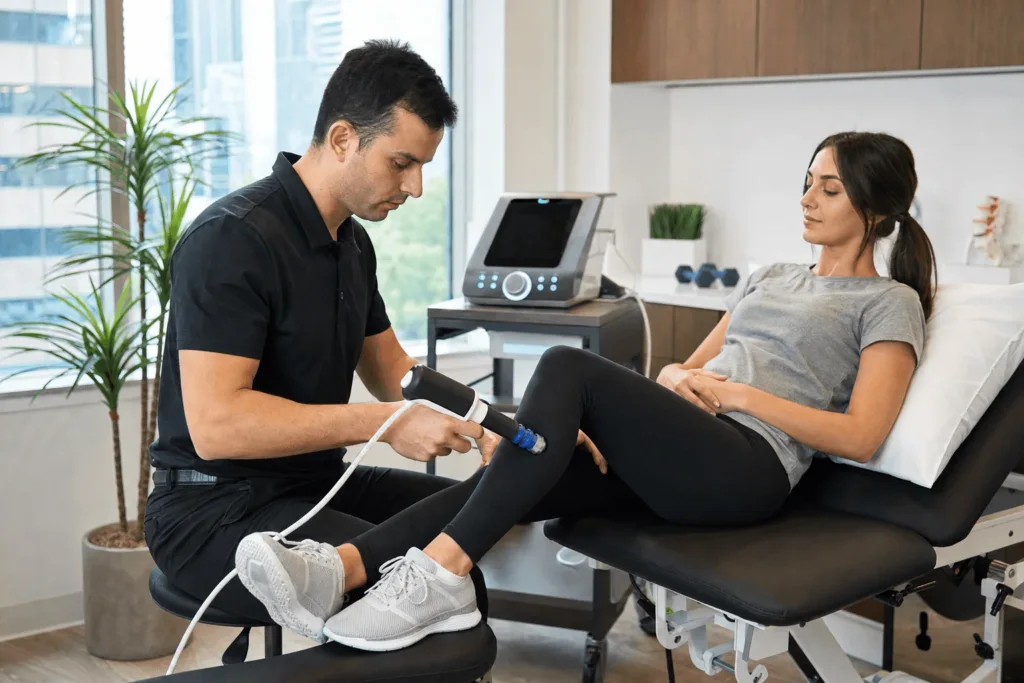
Shockwave therapy is a non-invasive treatment that uses high-energy acoustic waves to stimulate healing in injured tendons, ligaments, and other soft tissues. Also known as extracorporeal shockwave therapy (ESWT), this evidence-based physiotherapy modality has become increasingly popular for treating chronic musculoskeletal conditions like plantar fasciitis, Achilles tendonopathy, and calcific shoulder tendinitis. If you’re dealing with persistent pain that hasn’t responded to rest or traditional physiotherapy, understanding what shockwave therapy is and how it works can help you make an informed decision about your treatment options.
This guide explains the science behind shockwave therapy, the difference between radial and focused shockwave techniques, what conditions respond best to treatment, and what you can realistically expect during and after your sessions. You’ll also learn how shockwave compares to other conservative treatments and whether it’s the right choice for your specific condition.
Quick Answer
Shockwave therapy delivers high-energy acoustic waves to injured tissue to reduce pain and stimulate healing. It’s primarily used for chronic tendon conditions, takes 3-6 sessions to work, and causes temporary discomfort but minimal side effects.
What Is Shockwave Therapy?
Shockwave therapy is a non-surgical treatment that uses acoustic waves to create controlled microtrauma in damaged tissue. These high-energy sound waves penetrate deep into muscles, tendons, and ligaments, triggering the body’s natural repair mechanisms.
The technology originated from lithotripsy, a medical procedure used to break up kidney stones without surgery. Researchers discovered that the same acoustic wave technology could stimulate healing in musculoskeletal injuries. Today, shockwave therapy is widely used in physiotherapy clinics across Ontario and around the world.
Unlike ultrasound therapy, which uses low-intensity continuous waves, shockwave therapy delivers short, intense bursts of mechanical energy. These pulses create a cascade of biological responses: increased blood flow, reduced inflammation, and the breakdown of calcified deposits in tendons. The treatment is called “extracorporeal” because the energy source remains outside the body.
Key Takeaways
- Expect 3-6 treatment sessions spaced one week apart for chronic tendon conditions
- Choose radial shockwave for superficial tendon problems like plantar fasciitis
- Anticipate temporary discomfort during treatment that typically lasts 5-10 minutes
- Avoid NSAIDs for 48 hours post-treatment to maximize healing response
- Verify your insurance coverage as many Ontario plans include shockwave therapy
How Does Shockwave Therapy Work?
Shockwave therapy works through mechanical stimulation rather than heat or electrical current. When acoustic waves hit damaged tissue, they create several therapeutic effects that promote healing.
First, the waves trigger neovascularization, the formation of new blood vessels in the injured area. Better blood supply means more oxygen and nutrients reach the damaged tissue. This accelerates the healing process in chronic injuries where blood flow has become sluggish.
Second, the mechanical stress breaks down scar tissue and calcified deposits. Many chronic tendon injuries develop fibrous adhesions or calcium buildups that limit mobility and cause pain. The acoustic waves fragment these deposits, allowing your body to reabsorb them naturally.
Third, shockwave therapy releases substance P and other pain mediators from nerve endings. While this might sound counterintuitive, depleting these chemicals actually reduces pain sensitivity over time. The waves also stimulate the production of growth factors and stem cells, telling your body to restart the healing process in tissue that has been stuck in a chronic, non-healing state.
Many patients ask whether they should continue their regular physiotherapy exercises during shockwave treatment. Our North York team typically recommends maintaining your exercise program but reducing intensity for 48-72 hours after each session to let the healing response develop without interference.
Types of Shockwave Therapy: Radial vs Focused
Two main types exist, each with distinct characteristics and clinical applications. Understanding the difference helps explain why your physiotherapist might recommend one over the other.
| Feature | Radial Shockwave (RSWT) | Focused Shockwave (FSWT) |
|---|---|---|
| Energy pattern | Disperses outward from applicator | Converges at focal point |
| Penetration depth | 3-4 cm | Up to 12 cm |
| Best for | Superficial tendons, trigger points | Deep insertions, bone conditions |
| Common conditions | Plantar fasciitis, tennis elbow | Calcific deposits, non-union fractures |
| Discomfort level | Moderate | Higher intensity |
Radial shockwave therapy uses compressed air to accelerate a projectile inside the handpiece. When the projectile strikes the applicator, it creates a pressure wave that spreads outward. The energy disperses as it travels deeper, making it most effective for superficial conditions. Focused shockwave therapy concentrates acoustic waves at a specific depth, delivering higher intensity at the target site but requiring more expensive equipment.
Ready to start your recovery?
Our multidisciplinary team in North York offers physiotherapy, chiropractic, massage therapy, and more under one roof. Direct billing available, no referral needed.
Conditions Treated with Shockwave Therapy
Shockwave therapy works best for chronic tendon and soft tissue conditions that have persisted for at least three months. The most common applications involve overuse injuries in the lower limbs and shoulder.
Plantar fasciitis tops the list. Research on this painful heel condition shows promising results for many patients who have tried conservative treatments without success. Achilles tendonopathy, whether insertional or mid-portion, shows strong evidence for shockwave effectiveness. The therapy breaks down degenerative tissue and stimulates collagen remodeling in the tendon.
Lateral epicondylitis (tennis elbow) and medial epicondylitis (golfer’s elbow) respond to focused treatment at the tendon attachment on the elbow. Calcific shoulder tendinitis benefits from shockwave’s ability to fragment calcium deposits in the rotator cuff.
Other conditions that may benefit include patellar tendonopathy (jumper’s knee), greater trochanteric pain syndrome (hip bursitis), shin splints, myofascial trigger points, non-union bone fractures, and retrocalcaneal bursitis.
Benefits and Potential Side Effects of Shockwave Therapy
Understanding both the advantages and limitations of shockwave therapy helps set realistic expectations. No treatment works for everyone, and shockwave is no exception.
Key Benefits
The primary benefit is pain reduction without surgery or medication. Treatment is fast, taking only 5-10 minutes per session. You can return to work immediately after with no anesthesia or recovery time needed. Shockwave stimulates actual tissue healing, not just temporary symptom relief. The improved blood flow, collagen remodeling, and breakdown of calcifications address the root problem. Many patients maintain their improvements for years after completing treatment.
Side Effects and Contraindications
The most common side effect is temporary discomfort during treatment. Most patients describe it as tolerable, like a rubber band snapping against skin. Some people experience minor bruising, swelling, or redness at the treatment site. These effects typically resolve within 1-2 days.
Shockwave therapy is not appropriate for everyone. Contraindications include pregnancy, blood clotting disorders or anticoagulant medication use, active infection near the treatment area, tumors or cancer in the region, cortisone injection within the past 6 weeks, children with open growth plates, and pacemakers near the treatment site.
What to Expect During and After Treatment
Knowing what happens during a typical shockwave session reduces anxiety and helps you prepare properly. The process is straightforward and follows a consistent pattern across most clinics.
Your physiotherapist starts by assessing your injury and confirming that shockwave therapy is appropriate. They’ll palpate the painful area to identify the exact treatment location. You’ll be positioned comfortably with the affected area exposed and accessible. The therapist applies gel to your skin, similar to ultrasound gel, to ensure good contact between the device and your tissue.
During treatment, you’ll feel rhythmic pulsing as the device delivers acoustic waves. The sensation ranges from mild pressure to sharp discomfort depending on the tissue sensitivity and energy level used. A typical session delivers 2000-4000 shocks to the affected area in 5-10 minutes. Immediately after treatment, you might notice temporary numbness or tingling. Some people feel immediate pain relief, while others experience no change or even slight discomfort increase initially. Both responses are normal.
Aftercare Instructions Following Treatment
You can leave immediately and resume normal activities after your session. Avoid intense exercise involving the treated area for 48 hours. Light activity and gentle movement are fine. The treatment area may feel sore for 1-3 days afterward, similar to post-exercise muscle soreness. Apply ice if needed, but avoid anti-inflammatory medications for 48 hours. NSAIDs can interfere with the inflammatory healing response that shockwave triggers.
Most treatment protocols involve 3-6 sessions spaced one week apart. This gives tissue time to respond between treatments. Don’t expect instant results. Shockwave therapy works by stimulating a biological healing process that takes weeks to unfold. Most patients notice gradual improvement starting 2-4 weeks after beginning treatment. Maximum benefit typically occurs 8-12 weeks after completing the full series of sessions.
| Timeline | What to Expect | Activity Guidelines |
|---|---|---|
| During treatment (5-10 min) | Pulsing sensation, tolerable discomfort | Remain still, communicate with therapist |
| Immediately after | Possible numbness, redness at site | Resume normal activities, ice if needed |
| 24-72 hours post | Soreness, temporary pain increase possible | Avoid intense exercise, skip NSAIDs |
| Week 1-2 | Gradual pain reduction begins | Return to exercise gradually |
| Week 6-12 | Maximum benefit typically reached | Resume full activities as tolerated |
Shockwave Therapy vs Other Treatment Options
Shockwave therapy occupies a specific niche in the treatment hierarchy for chronic musculoskeletal conditions. Understanding how it compares to other options helps determine when it’s the right choice.
| Treatment | Timeline for Results | Invasiveness | Best Used When |
|---|---|---|---|
| Exercise therapy | 6-12 weeks | Non-invasive | First-line treatment for most conditions |
| Shockwave therapy | 8-12 weeks | Non-invasive | Exercise alone hasn’t resolved chronic pain |
| Cortisone injection | Days to weeks | Minimally invasive | Quick symptom relief needed |
| PRP injection | 8-16 weeks | Minimally invasive | Non-invasive methods have failed |
| Surgery | 3-6 months | Invasive | Structural damage or conservative care failed |
Conservative physiotherapy, including traditional physiotherapy treatments like exercise prescription and manual therapy techniques, should almost always come first. These approaches work for many people, cost less, and build the strength and mobility you need regardless of what other treatments you pursue. The limitation is that some chronic tendon conditions reach a point where exercise alone cannot stimulate further healing.
Cortisone injections provide faster initial pain relief than shockwave. You might feel 50-70% better within days. But the effect is temporary, lasting weeks to months rather than years. Shockwave takes longer to work but promotes actual tissue healing. The results tend to last because you’ve addressed the underlying degeneration, not just suppressed inflammation.
At ProMed Wellness Centre, our North York physiotherapy team typically recommends a stepped approach: start with exercise and manual therapy for 6-12 weeks, add shockwave therapy if progress stalls, and consider injections or surgical referral only after exhausting conservative options. Shockwave is most appropriate when you have chronic tendon pain lasting more than 3 months, have completed at least 6 weeks of exercise therapy without adequate improvement, want to avoid injections or surgery, and have no contraindications to the treatment.
Frequently Asked Questions About Shockwave Therapy
What is shockwave therapy used for?
Shockwave therapy treats chronic tendon conditions including plantar fasciitis, Achilles tendonopathy, tennis elbow, golfer’s elbow, calcific shoulder tendinitis, and patellar tendonopathy. It’s most effective for injuries persisting at least 3 months that haven’t responded to rest or traditional physiotherapy.
Does shockwave therapy hurt during treatment?
Shockwave therapy causes temporary discomfort during the 5-10 minute session. Most patients describe it as tolerable, similar to a rubber band snapping against skin. The sensation varies by tissue sensitivity and energy level. You can ask your therapist to adjust intensity if needed. Discomfort stops immediately when treatment ends.
How long does it take for shockwave therapy to work?
Shockwave therapy requires 3-6 sessions spaced one week apart. Most patients notice gradual pain reduction 2-4 weeks after starting treatment. Maximum benefit usually occurs 8-12 weeks after completing the full series. The therapy stimulates a biological healing process that takes time to unfold.
What are the side effects of shockwave therapy?
Common side effects are minor and temporary: discomfort during treatment, mild soreness for 1-3 days afterward, and occasional bruising or redness at the site. Some patients experience temporary pain increase for 24-48 hours before improvement begins. Serious side effects are rare.
Is shockwave therapy covered by insurance in Ontario?
Many private insurance plans in Ontario cover shockwave therapy when provided by a registered physiotherapist. Coverage depends on your policy and whether you have physiotherapy or extended health benefits. OHIP does not cover it. At ProMed Wellness Centre, we offer direct billing to most insurance companies. Contact your insurer to confirm coverage before starting treatment.
Making an Informed Decision About Shockwave Therapy
Shockwave therapy offers a non-invasive, evidence-based option for chronic tendon conditions that haven’t responded to rest or traditional physiotherapy. It works by stimulating your body’s natural healing mechanisms rather than just masking pain. The treatment requires patience, as results develop gradually over weeks, but the benefits tend to last because you’re addressing the underlying tissue dysfunction.
The best candidates are people with persistent tendon pain who have tried conservative treatments without success but want to avoid injections or surgery. If you’ve been dealing with plantar fasciitis, Achilles pain, tennis elbow, or similar conditions for months, shockwave therapy combined with appropriate exercise rehabilitation might be the approach that finally gets you better.
If you’re in North York or the Greater Toronto Area and wondering whether shockwave therapy is right for your condition, our team at ProMed Wellness Centre can help you make that decision. We offer comprehensive assessments to determine the most appropriate treatment approach for your specific situation. Book a consultation at our clinic on Finch Avenue West or call (647) 349-8765 to discuss your options with our physiotherapy team. No referral needed.